
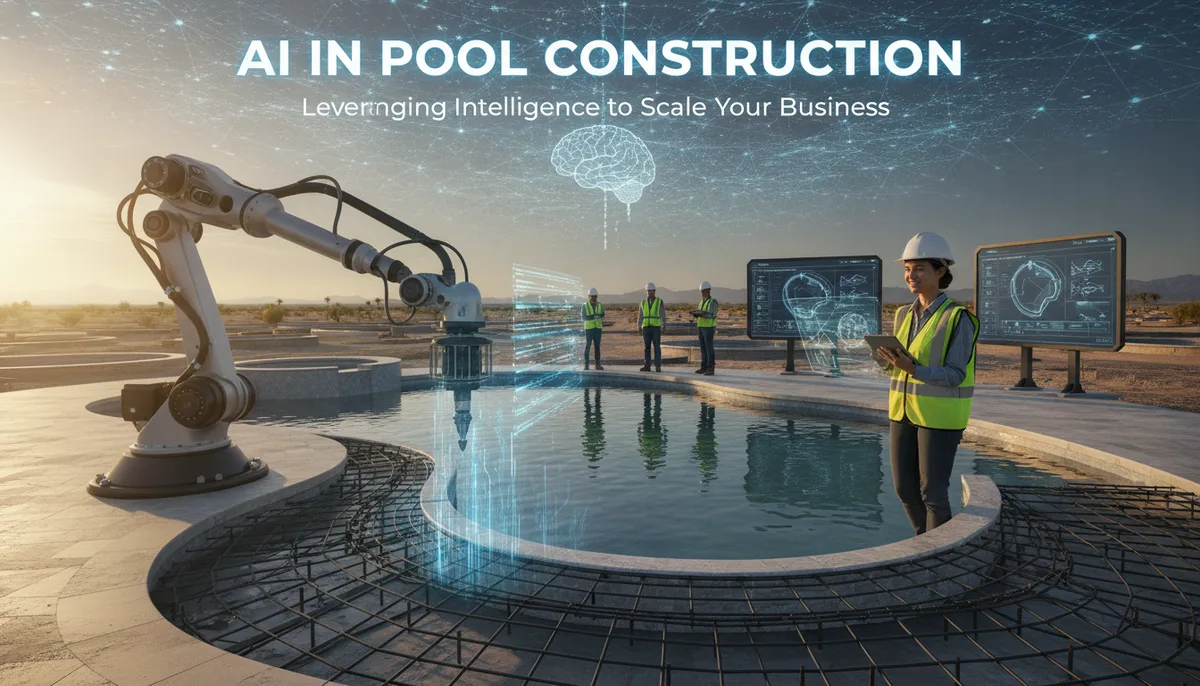
AI in Pool Construction: Leveraging Intelligence to Scale Your Business
The swimming pool construction industry is undergoing a digital transformation that goes far beyond simple 3D design software. For years, builders have relied on construction management platforms (CMPs) to organize the chaos of multi-month builds, subcontractor scheduling, and complex budgeting. However, the emergence of Artificial Intelligence (AI) has introduced a new variable into the equation.
For many pool builders, the question is no longer "Should I use AI?" but rather "How do I make AI actually work for my business?" On its own, a general AI tool is like a brilliant new hire who has read every textbook ever written but has never actually stepped onto a job site. To make it useful, you have to give it access to your "field experience"—which, in the modern era, is your business data.
The Gap Between General AI and Construction Logic
If you ask a standard AI assistant to "write a pool construction schedule," it will give you a generic list of steps: excavation, plumbing, steel, shotcrete, tile, and deck. While accurate in a vacuum, it doesn't know that your preferred electrician is booked three weeks out, or that your local municipality has a backlog on Pool Electrical Safety: A Comprehensive Guide to Bonding, Grounding, and Inspections.
As Eric Fortenberry, CEO of JobTread, aptly puts it: “Think of it as a Harvard grad with no field experience. AI is really powerful, but it is not your business system.”
The true power of AI in the pool industry is realized only when it is connected to a construction management platform. This platform serves as the "brain" of your operation, housing your estimates, budgets, proposals, and schedules. When AI is granted access to this data, it transitions from a generic chatbot to a specialized project coordinator that understands your specific workflows.
Connecting the "Brain" to the "Engine"
To understand how to implement AI, you must first understand the role of your construction management platform. A CMP is the repository for every critical piece of information regarding a build. It knows:
- The exact margin you need to hit on every plumbing line item.
- The communication history with a specific homeowner.
- The availability of your project managers.
- The status of every purchase order (PO).
When you connect an AI assistant to this data, you create a feedback loop. Instead of manually digging through spreadsheets to see if a project is over budget, you can simply ask the AI, "Which of my active jobs are currently 5% over their estimated labor costs?" The AI reads the data from the CMP and provides an instant answer, saving hours of manual auditing.
Automating the Admin: From Lead to Purchase Order
One of the most significant "time-sinks" in pool construction is manual data entry. Every new lead requires a name, address, and project scope to be entered into the system. Once a contract is signed, that data must be translated into a budget, which then becomes a series of purchase orders.
Modern AI integrations are now capable of handling this entire chain. Fortenberry highlights a use case where AI reads a homeowner’s initial quote request and automatically:
- Creates the new job profile in the system.
- Populates budget line items based on the requested features (e.g., adding a heater or an automated cover).
- Generates the necessary purchase orders for long-lead items.
- Schedules the work with the appropriate project manager assigned based on current workloads.
This level of automation ensures that nothing falls through the cracks during the transition from sales to production. It allows the builder to focus on the technical aspects of the build, such as ensuring proper application during the finishing stages, as detailed in The Professional’s Guide to Swimming Pool Painting: Application Mastery and Environmental Control.
Field Efficiency: Voice-to-Data Workflows
The life of a pool builder is rarely spent behind a desk. Most of the day is spent in a truck or on-site, navigating the logistical hurdles of construction. Historically, this made "daily logs" a chore that was often skipped or completed with minimal detail at the end of a long week.
AI changes this dynamic through voice-to-data integration. Using a smartphone or tablet, a production manager can walk a site and simply talk to the assistant.
- "The steel phase is 90% complete, but we’re waiting on the inspector for the deep end bonding. Move the shotcrete schedule back by two days and notify the crew."
The AI doesn't just record the audio; it parses the instructions. It updates the project schedule, sends the notification to the subcontractor, and logs the delay in the project history. This ensures that the "real world" of the job site and the "digital world" of the management software remain in perfect sync.
Data-Driven Management: The Coastal Pools Case Study
The most sophisticated use of AI in the pool industry today isn't about writing emails; it's about synthesizing complex data to make better management decisions. Mel Gowl, a production manager at Coastal Pools, provides a blueprint for this.
Gowl faced a common challenge: how to fairly evaluate six different project managers (PMs) who were all managing different types of builds in different locations. While the company was good at looking at individual Key Performance Indicators (KPIs), they lacked a holistic view of performance.
By using an AI assistant connected to their construction management platform, Gowl built a custom scorecard system. This system tabulates a single employee score based on:
- Margin Performance: How well the PM kept the project within the estimated costs compared to the company average.
- Change Order Revenue: Whether the PM was identifying and capturing additional revenue opportunities.
- Customer Reviews: Sentiment analysis of feedback provided by the homeowners.
“In this scenario, AI has really only helped me compile all the data into one place,” Gowl explains. “We were very good at looking at a singular KPI but didn’t have a great way to compile all the KPIs and tell the full story of how that PM is doing.”
This data-driven approach removes emotion from performance reviews and allows the company to fuel its bonus programs with objective facts. It transforms the PM role from "firefighter" to "profit center."
Implementation Strategy: How to Get Started
For pool builders looking to integrate AI into their workflow, the path forward involves three specific steps:
1. Audit Your Current Software Stack
AI cannot help you if your data is scattered across paper files, personal text messages, and disconnected spreadsheets. Your first priority is ensuring you are using a robust construction management platform that offers an API or direct AI integration.
2. Identify Your "Friction Points"
Where does your team spend the most time on "low-value" tasks? Is it answering "Where is my pool?" emails from homeowners? Is it chasing down receipts? Identify these friction points and look for AI tools that specifically address data entry or communication.
3. Start with a Single Use Case
Don't try to automate your entire business overnight. Start with a single, high-impact use case—such as automating daily logs or creating a project manager scorecard. Once that system is refined and providing value, move to the next automation.
The Future of the "Intelligent" Pool Business
The integration of AI into pool construction software represents a shift from "reactive" management to "proactive" management. In a reactive model, you find out a project lost money three weeks after it’s finished. In a proactive, AI-driven model, the system alerts you the moment a budget line item deviates from the estimate, allowing you to course-correct in real-time.
As the industry continues to evolve, the builders who thrive will be those who view AI not as a replacement for human expertise, but as the connective tissue that makes their existing software and staff more effective. AI isn't replacing your software; it is finally making it work at the speed of your business.