
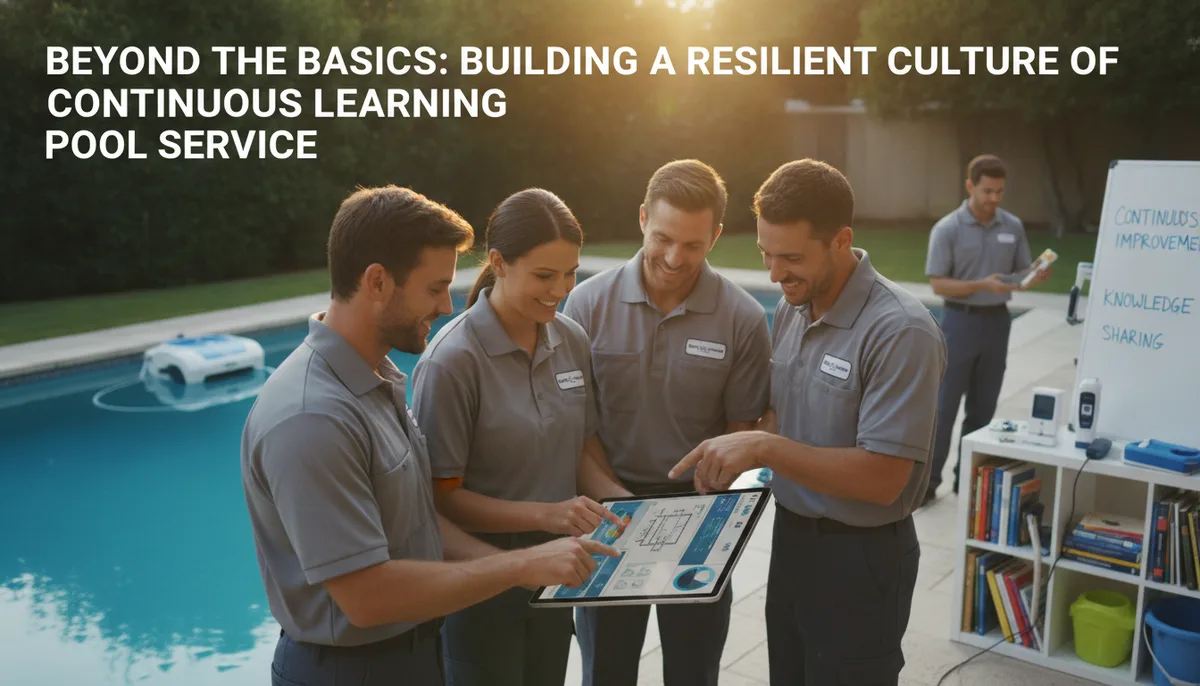
Beyond the Basics: Building a Resilient Culture of Continuous Learning in Pool Service
In an era where finding seasoned service technicians is increasingly difficult, the pool and spa industry has shifted its focus toward internal development. Many leading companies now prefer to hire for "attitude and aptitude" rather than specific experience, choosing to mold raw talent into professional experts. However, the most successful firms recognize that training isn't a one-time event—it is a perpetual process.
Moving a new hire from a trainee to a full-fledged service technician is only the first step. To maintain a competitive edge and ensure long-term employee retention, pool service businesses must cultivate a culture of learning. This environment ensures that education isn't viewed as a chore or a mandatory hurdle, but as a continuous momentum that empowers the individual and the team.
The Law of Reciprocity: Reducing the "Fear Factor"
For a new technician, the first few weeks on the job are often defined by anxiety. The "fear factor"—the worry of breaking expensive equipment, failing to balance chemistry, or letting the team down—can be a significant barrier to effective learning.
Rich Gallo, CEO of Pure Swim in Los Angeles, addresses this head-on by introducing the Law of Reciprocity. This isn't just a philosophical concept; it is a foundational rule of his team's operation. Gallo explains to every new hire that while they are there to learn, they are also there to contribute.
The core message is simple: "Imagine the guy to the left and your right has your back, because you have their backs." When a technician knows they aren't an island, their sense of empowerment skyrockets. By fostering an environment where asking for help is encouraged rather than penalized, the "fear factor" is replaced by a sense of collective responsibility. This psychological safety is the bedrock upon which a culture of learning is built.
Leveraging Technology for Real-Time Education
The days of technicians carrying bulky service manuals in their trucks are fading. Today, the most effective training happens in real-time, facilitated by the devices already in the technicians' pockets.
Nick Day, General Manager of Gohlke Pools, utilizes Microsoft Teams to bridge the gap between the office and the field. By creating a digital "hive mind," technicians can instantly share photos of a confusing plumbing manifold or a malfunctioning heater with the entire group.
The Benefits of Instant Feedback
- Reduced Errors: Technicians get immediate verification before making a repair.
- Collective Learning: When one technician asks a question and receives an answer, every other technician on the thread learns something new.
- Managerial Oversight: Management can spot recurring issues or knowledge gaps across the entire fleet in real-time.
This use of technology transforms every service call into a potential classroom. It ensures that even the most remote technician has access to the company’s collective expertise at the touch of a button. For those looking to upgrade their team's field capabilities, investing in high-quality testing equipment is a great first step.
Incentivizing Growth: Linking Knowledge to Reward
While the intrinsic value of learning is high, tangible incentives can significantly accelerate a team's dedication to professional development. The pool industry has found creative ways to reward those who take their education seriously.
Commission-Based Incentives
At Gohlke Pools, the link between knowledge and earnings is made explicit. Technicians who understand the nuances of pool equipment are better equipped to recommend necessary upgrades or preventative maintenance. This leads to higher commission earnings for the technician and better-maintained pools for the client.
Furthermore, the company rewards route supervisors based on the performance of their direct reports. This creates a "train-the-trainer" environment where supervisors are financially motivated to ensure their maintenance techs are performing at their peak. For a deeper look at the technical standards these techs should be aiming for, see The Pool Logic Master Buying Guide: Infrastructure, Filtration, and Maintenance.
Education as a Reward
All Seasons Pools, Spas & Outdoor Living has taken incentives a step further by making education itself the prize. Through a points-based system, employees earn trips to national trade shows, such as the Northeast Spa and Pool Association’s Pool and Spa Show.
Employees earn points by:
- Attending internal training events.
- Securing five-star customer reviews.
- Meeting sales targets for specific products.
This approach reframes "extra" training not as more work, but as a pathway to networking, travel, and professional prestige.
Specialized Training: Mastering the "Why" Behind the "How"
A culture of learning must move beyond basic "skim and scrub" techniques. As pool technology becomes more sophisticated, technicians need to understand the chemistry and physics involved in modern pool care.
One area where specialized training pays dividends is in advanced water chemistry. For example, teaching technicians the benefits of borates can transform a standard service route into a premium experience. Understanding how borates act as a pH buffer and algaestat allows technicians to provide "crystal clear stability" that competitors might struggle to achieve. For teams looking to implement these advanced techniques, our resource on The Ultimate Guide to Borates: Achieving Crystal Clear Stability in Your Pool serves as an excellent training supplement.
When technicians understand the "why"—the science behind the chemicals—they become consultants rather than just laborers. This shift in identity is a powerful motivator for long-term career satisfaction.
Maintaining Momentum During the Busy Season
The biggest threat to a culture of learning is the "summer rush." When the phone is ringing off the hook and the heat is rising, training is often the first thing to be sacrificed. However, industry veterans argue that this is exactly when training is most vital.
Scheduled Intervals
Training should be a routine part of the calendar, regardless of the season. While the off-season allows for deep-dive seminars and multi-day workshops, the busy season should include "micro-training" sessions. These can be 15-minute "toolbox talks" on Friday mornings or brief video updates sent to the team's mobile devices.
The Role of Route Supervisors
During the busy months, route supervisors play a critical role in maintaining educational momentum. By performing "ride-alongs" or "spot checks," they can provide on-the-spot coaching. This prevents bad habits from forming under the pressure of a heavy workload.
To ensure your team has the best equipment to work with during these busy intervals, consider upgrading to high-efficiency filtration systems that require less frequent intervention.
Conclusion: The Long-Term ROI of Education
Building a culture of learning is an investment in the most valuable asset of any pool service company: its people. By implementing the Law of Reciprocity, leveraging modern communication technology, and creating robust incentive structures, business owners can create a self-sustaining cycle of improvement.
When technicians feel supported, empowered, and rewarded for their knowledge, they are more likely to stay with the company and provide the high level of service that drives customer loyalty. In the end, a well-trained team doesn't just fix pools—they build a reputation for excellence that sustains the business for years to come.