
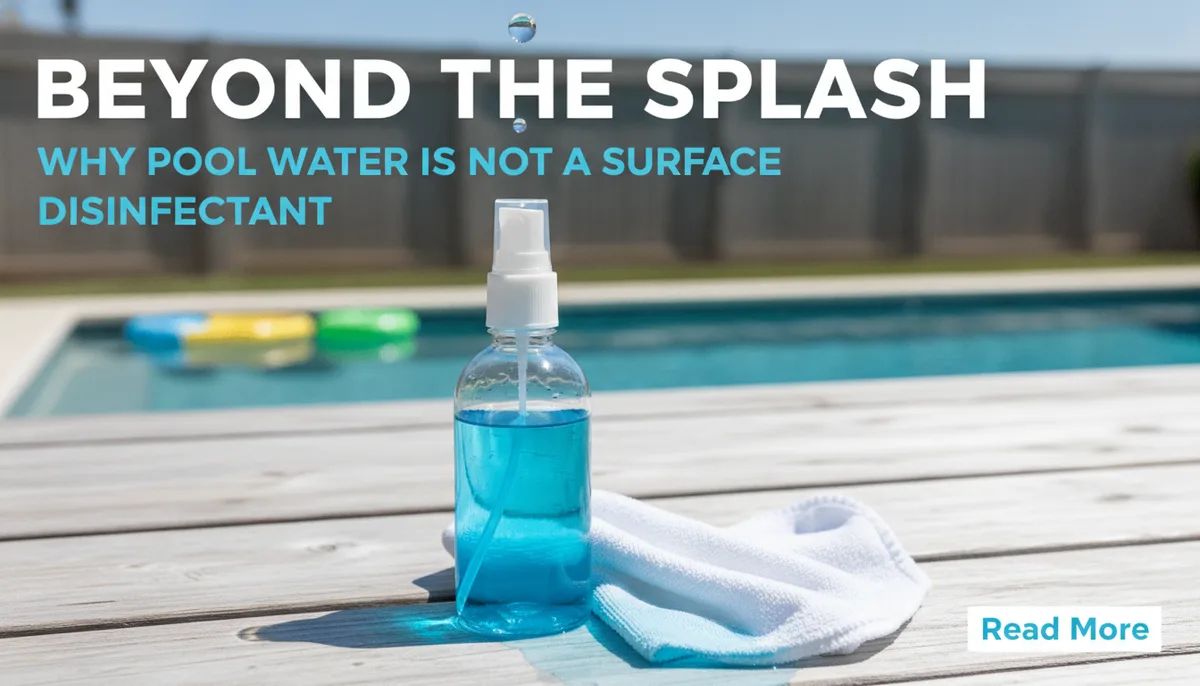
Beyond the Splash: Why Pool Water Is Not a Surface Disinfectant
The Myth of the "Chlorine Dip"
For decades, there has been a lingering assumption among pool owners and aquatic facility managers that chlorinated water is a universal solvent for germs. The logic seems sound on the surface: if chlorine is powerful enough to keep thousands of gallons of water clear and safe for hundreds of swimmers, surely a quick dunk of a kickboard or a pair of shared goggles into that same water should be enough to sanitize them.
However, as we have learned through rigorous health evaluations and official guidance from the Centers for Disease Control and Prevention (CDC), this assumption is not only incorrect but potentially hazardous. While properly treated water is safe from coronavirus transmission during the act of swimming, it is not a suitable medium for disinfecting objects or surfaces.
Understanding the distinction between "treated water safety" and "surface disinfection" is critical for anyone managing a public pool, a community aquatic center, or even a busy backyard pool where neighborhood children share toys.
The Science of Concentration: Why 1 PPM Isn't Enough
The primary reason pool water fails as a disinfectant for objects lies in the science of concentration. In a standard swimming pool, free available chlorine (FAC) levels are typically maintained between 1.0 and 4.0 parts per million (ppm). At these levels, chlorine is highly effective at neutralizing pathogens over time as they are diluted within the massive volume of the pool.
When we talk about disinfecting a surface—such as a plastic slide, a shared life jacket, or a pool-side table—we are dealing with a much higher density of potential viral load on a non-porous or porous material. To achieve true disinfection on these surfaces, the concentration of the sanitizing agent must be significantly higher than what is found in a swimming pool.
For perspective, a standard bleach solution used for disinfecting hard surfaces often requires a concentration of approximately 1,000 ppm of chlorine. Expecting a pool’s 2 ppm environment to do the same job as a 1,000 ppm solution is a dangerous oversight. There have been no scientific studies to suggest that the low concentrations found in treated pool and spa water can provide the rapid "kill time" necessary to sanitize an object before it is passed from one person to another.
Lessons from the CDC Webinars
In a series of informative webinars, representatives from the CDC addressed the specific concerns of the aquatics industry regarding the COVID-19 pandemic and general viral transmission. When asked directly if pool water was sufficient to disinfect shared items in public settings, the answer was a definitive "no."
The CDC’s stance is rooted in two primary factors:
1. Lack of Empirical Data
There is a lack of experimental data to support the efficacy of low-concentration pool water as a surface disinfectant. Disinfection protocols require "contact time"—the duration a surface remains wet with a disinfectant. Because pool water is so dilute, the contact time required to kill a virus on a plastic toy might be far longer than the time it takes for that toy to air dry or be handed to the next child.
2. The Instability of Coronaviruses
While it is true that the CDC believes treated water is safe from coronavirus transmission, this is largely due to the biological profile of the virus itself. Coronaviruses are "enveloped" viruses, meaning they have a lipid outer layer that is relatively easy to break down. Other coronaviruses have been shown to be inactivated by as little as 0.5 ppm of chlorine in water. However, this inactivation happens within the water column, where the virus is surrounded by the sanitizer. On a surface, environmental factors like UV light, heat, and organic load (sweat, oils, dirt) can shield the virus from the weak chlorine levels of pool water.
Managing Shared Equipment in Public Settings
If you are operating a public or semi-public facility, the goal should be to minimize the sharing of objects entirely. When sharing is unavoidable, a rigorous cleaning protocol must be established that bypasses the pool water entirely.
Step 1: Cleaning vs. Disinfecting
It is important to distinguish between cleaning and disinfecting. Cleaning involves using soap and water to physically remove dirt and organic matter. This should always be the first step. Once the object is clean, you apply an EPA-registered disinfectant.
Step 2: Selecting the Right Product
The EPA maintains "List N," which includes disinfectants that meet their criteria for use against SARS-CoV-2. These products are formulated to stay active on a surface long enough to neutralize the virus.
Step 3: Proper Contact Time
Every disinfectant has a required "dwell time" or "contact time." This is the amount of time the surface must remain visibly wet with the disinfectant to be effective. Simply spraying and immediately wiping is often ineffective.
The Role of Water Quality in Overall Safety
While pool water shouldn't be used to clean surfaces, maintaining the health of the water is still the first line of defense for the swimmers themselves. If your water chemistry is off, you aren't just failing to disinfect surfaces; you are failing to keep the swimming environment safe.
Properly balanced water relies on more than just chlorine. It requires efficient circulation and filtration. To understand how your equipment contributes to this ecosystem, you might find our guide on The Science of Pool Filtration: Optimizing Pump Flow for Crystal Clear Water helpful. A well-filtered pool ensures that the chlorine you do have in the water is free to work on pathogens rather than struggling against organic debris.
Furthermore, safety in the pool area extends beyond chemistry. Ensuring that your facility is physically safe is just as vital as viral prevention. This includes regular checks of your electrical systems. For a deep dive into these requirements, see our Pool Electrical Safety: A Comprehensive Guide to Bonding, Grounding, and Inspections.
Practical Guidance for Residential Pool Owners
For homeowners, the risks are lower than in a high-traffic public water park, but the principles of hygiene remain the same. If you are hosting a pool party or have guests over, follow these practical tips:
- Assign Equipment: Give each child their own designated noodle or kickboard for the day.
- Fresh Water Rinse: After a swim session, rinse all toys with fresh water and a mild detergent rather than just leaving them to dry with pool water on them.
- Sunlight as an Aid: While not a substitute for medical disinfection, the UV rays from the sun can help degrade pathogens on surfaces over time. However, do not rely on sunlight alone for items that are frequently handled.
- Storage: Store clean, dry equipment in a ventilated area to prevent the growth of mold and mildew, which can further compromise the hygiene of your pool area.
Summary of Best Practices
To ensure the safety of your swimmers and the hygiene of your equipment, adhere to the following summary of professional recommendations:
- Do Not Rely on Pool Water: Never use the pool as a "sanitizing dip" for shared items.
- Use Approved Chemicals: Only use EPA-registered disinfectants for surfaces and shared equipment.
- Follow the Label: Adhere strictly to the contact time specified on the disinfectant's label.
- Maintain Water Chemistry: Keep your FAC between 1-4 ppm and pH between 7.2-7.8 to ensure the water itself remains a hostile environment for viruses.
- Encourage Personal Hygiene: Remind swimmers to wash their hands frequently and shower before entering the pool to reduce the organic load in the water.
By moving away from the "chlorine dip" mentality and adopting professional-grade sanitation habits, you can provide a safer, healthier environment for everyone in the water. Pool safety is a multi-layered approach, and understanding the limits of your pool water is a vital part of that strategy.