
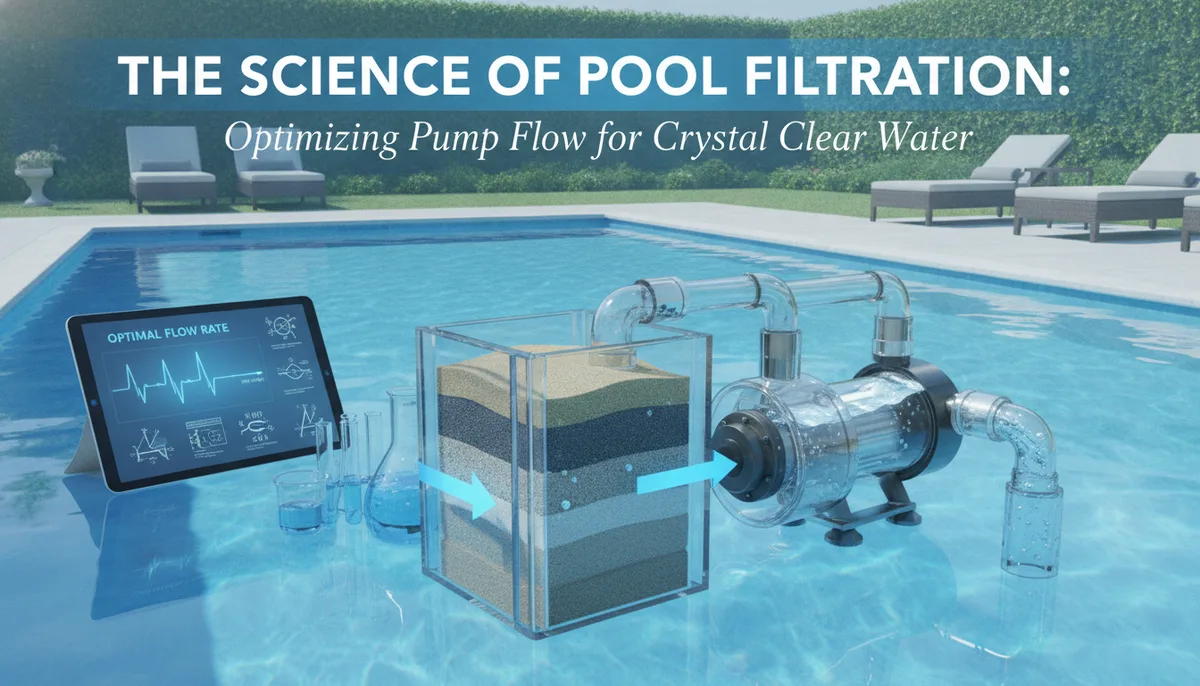
The Science of Pool Filtration: Optimizing Pump Flow for Crystal Clear Water
The Filtration-First Philosophy: Beyond Chemicals
In the world of pool maintenance, there is a common misconception that crystal-clear water is solely the result of a perfect chemical balance. While sanitizers and balancers are essential for safety, even the most advanced chemical programs cannot compensate for a failing filtration system. In fact, chemical manufacturers frequently point out that their products are only as effective as the filter allows them to be.
With the recent shifts in the global supply chain, sanitizers have occasionally been in high demand and low supply. This reality has forced a return to the fundamentals: maximizing the mechanical ability of the filter to remove organic matter before it can consume your chlorine. Whether you are operating a sand, Diatomaceous Earth (DE), or cartridge system, the secret to water perfection lies in the relationship between the pump and the filter.
To achieve a truly "polished" look in pool water, professionals must look beyond the bottle and focus on hydraulics. Understanding how water moves through media is the first step in transitioning from a basic service provider to a pool water expert.
Understanding Water Velocity: Why Slower is Better
The most frequent mistake seen in the field is the installation of an oversized pump. On the surface, a more powerful pump seems like an upgrade—more power should mean cleaner water, right? In hydraulics, the opposite is often true.
Filtration systems are designed to operate within a specific water-flow range. When water moves through the filter media too quickly, it creates high velocity that "pushes" debris through the media rather than allowing the media to "catch" it.
- Better Separation: The slower the water moves, the more efficiently the filter can separate fine debris from the water stream.
- Reduced Compaction: High-velocity water can compact sand or DE beds, creating "channels" where water bypasses the media entirely.
- Energy Efficiency: Slower flow rates, often achieved through variable speed drives, significantly reduce energy consumption while improving clarity.
To ensure you aren't overpowering your system, you must match the pump's output to the filter's surface area. For a deeper dive into how filtration fits into your overall equipment pad, consult The Pool Logic Master Buying Guide: Infrastructure, Filtration, and Maintenance.
Calculating the Correct Filter Size
Properly sizing a filtration system requires more than a "best guess" based on pool volume. It requires adherence to industry standards for filtration surface area. Each type of media has a maximum flow rate it can handle per square foot of surface area.
High-Rate Sand Filtration
Sand filters are robust but sensitive to flow rates. The standard for high-rate sand is 15 gallons per minute (GPM) per square foot of filtration surface area. If you exceed this, you risk "mudballing" the sand or pushing dirt straight back into the pool.
Diatomaceous Earth (DE)
DE filters provide the finest mechanical filtration. To maintain this precision, you should allow for 1 to 2 GPM per square foot of surface area. Because DE is so fine, pushing water too fast can strip the DE from the grids or cause the system to clog prematurely.
Cartridge Filtration
Cartridge filters have the largest surface area but require the lowest velocity. You should limit flow to 0.375 GPM per square foot of surface area. Because the media is a pleated fabric, high pressure can distort the pleats and allow bypass.
For those managing specific residential setups, such as 18-foot above-ground models, seeing these numbers in action is helpful. Check out our analysis on Best Sand Filters for 18-Foot Circular Pools: GPH and Turnover Analysis for a practical breakdown.
The "Oversized Pump" Trap and Backwash Failure
While a pump that is too strong ruins filtration, a pump/filter mismatch can also cause issues during the cleaning cycle. This is particularly prevalent in sand filters.
If a pump is improperly sized—or if the plumbing is too restrictive—the system may fail to achieve the required flow rate for an effective backwash. When a sand filter is not backwashed with enough force to lift and "fluidize" the sand bed, debris remains trapped.
The Silt Effect: A tell-tale sign of inadequate backwash flow is the appearance of "silt" or fine debris coming out of the returns for the first few minutes after the system is returned to filter mode. This isn't just an aesthetic issue; that remaining silt works its way deeper into the sand bed over time. Eventually, this leads to "calcification" or "channeling," requiring an expensive sand change or even a total filter replacement.
Managing Turnover and Flow Dynamics
To size a system correctly, you must first determine the pool's required turnover rate. This is the amount of time it takes for the entire volume of pool water to pass through the filter once.
The Math of Turnover: If you have a commercial pool of 150,000 gallons and local health codes require a six-hour turnover:
- 150,000 gallons / 6 hours = 25,000 gallons per hour.
- 25,000 / 60 minutes = 416 GPM.
The challenge for the pool professional is that a filter's resistance changes. A "clean" filter has low resistance (low head), meaning the pump will push more water. A "dirty" filter has high resistance, meaning the pump will push less water.
When sizing the system, you must account for three specific scenarios:
- Clean Filter Flow Rate: Can the filter handle the maximum flow the pump will produce when the media is brand new?
- Dirty Filter Flow Rate: Will the pump still meet the minimum turnover requirements (e.g., 416 GPM) even when the filter is dirty and resistance is high?
- Backwash Flow Rate: Does the pump have enough "oomph" to meet the manufacturer’s backwash requirements?
Diagnosing Existing Systems: The TDH Equation
If you are called to a pool that has perpetually cloudy water despite "perfect" chemicals, you need to assess the existing hardware. You cannot simply look at the horsepower on the pump motor, as plumbing friction (Total Dynamic Head) dictates the actual performance.
To find the true flow rate of an existing system, follow these professional steps:
- Apply this TDH number to the manufacturer’s pump curve (a graph provided by the pump maker) to find the exact GPM the system is currently moving.
If the GPM exceeds the filter's rated capacity (based on the 15 GPM/sq ft for sand, etc.), you have found the culprit for the cloudy water.
Maximizing Efficiency with Modern Technology
Once the hydraulics are balanced, you can incorporate secondary tools to achieve "water perfection."
Variable Frequency Drives (VFDs): VFDs allow you to dial in the exact RPM needed to hit your target GPM. This eliminates the "oversized pump" problem entirely, as you can electronically limit the pump's output to match the filter's sweet spot.
Automatic Controllers: Modern controllers can monitor the pressure differential across the filter. When the pressure rises—indicating the filter is dirty and flow is dropping—the controller can ramp up the pump speed to maintain the required turnover rate, then alert the owner when a backwash is finally necessary.
Chemical Enhancements: While the filter does the heavy lifting, certain chemicals can assist the process. For example, using borates can help stabilize pH and add a "shimmer" to the water that mechanical filtration alone might miss. To learn more about this advanced water chemistry, see The Ultimate Guide to Borates: Achieving Crystal Clear Stability in Your Pool.
By mastering the relationship between water flow and filtration media, you ensure that the pool is not just chemically safe, but mechanically pristine. Proper sizing, regular diagnostic checks, and a "slow and steady" approach to water velocity are the hallmarks of a professional-grade pool system.