
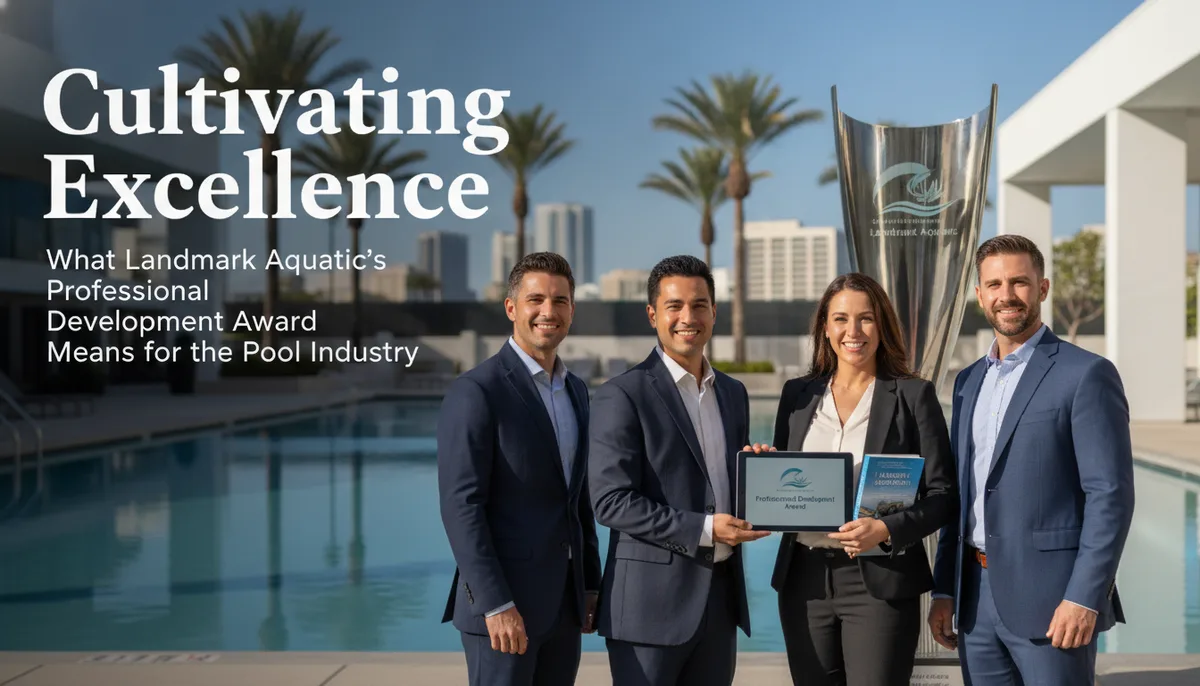
Cultivating Excellence: What Landmark Aquatic’s Professional Development Award Means for the Pool Industry
The aquatics and pool service industry has long been characterized by its seasonal nature and high-intensity labor. However, a significant shift is occurring as leading organizations move away from "churn-and-burn" staffing models toward sustainable, growth-oriented workplace cultures. A primary example of this evolution is Landmark Aquatic, which was recently honored with the 2026 Top Workplace Culture Excellence Award for Professional Development.
This recognition, developed by the research firm Energage, highlights a critical truth in the modern business landscape: the strength of an organization is directly proportional to the growth of its individual members. For Landmark Aquatic, this award isn't just a trophy for the shelf; it is a validation of a long-term strategy that prioritizes continuous learning, cross-team collaboration, and clear advancement paths.
The Landmark Aquatic Philosophy: Investing in People
At the heart of Landmark Aquatic’s success is a leadership philosophy that views employees as long-term assets rather than temporary labor. CEO J. Ryan Casserly summarizes this approach succinctly: “Winning the Top Workplace Culture Excellence Award for Professional Development is a direct result of a belief we’ve held from day one: that when you invest in your people’s growth, they invest back in the mission.”
In an industry where technical errors can lead to significant liability or safety hazards, this "investment" translates to a more competent, confident, and loyal workforce. By providing employees with a blueprint for making better decisions—from initial selection to eventual succession—Landmark Aquatic has created an environment where the "mission" of the company becomes a shared goal among the entire staff.
The Role of Energage in Benchmarking Excellence
The Top Workplaces award is not a subjective popularity contest. It is based on a rigorous framework developed by Energage, which analyzes employee feedback and organizational structures. For Landmark Aquatic, the data reflected a commitment to ensuring employees have access to the tools they need to master their craft. This includes:
- Continuous Learning: Providing ongoing training sessions that go beyond basic maintenance.
- Cross-Team Collaboration: Breaking down silos so that design, construction, and service teams understand each other's challenges.
- Clear Advancement Paths: Ensuring that a technician entering the field today knows exactly what steps are required to reach a management or specialized role tomorrow.
Why Professional Development is Non-Negotiable in Modern Aquatics
The pool industry is becoming increasingly complex. We are no longer just dealing with "chlorine and a scrub brush." Modern aquatic facilities involve sophisticated automation, complex hydraulic systems, and stringent environmental regulations.
When a company like Landmark Aquatic prioritizes professional development, they are essentially future-proofing their business. Employees who are encouraged to grow are more likely to stay updated on the latest industry standards, such as those found in The Professional’s Guide to Swimming Pool Painting: Application Mastery and Environmental Control. Mastery of these niche skills ensures that the company provides a superior product while minimizing costly re-dos.
Bridging the Technical Gap
Professional development also serves to bridge the gap between entry-level tasks and high-level technical mastery. For example, a junior technician might understand how to balance water chemistry, but through a structured development program, they can evolve into an expert who understands the nuances of equipment efficiency.
Understanding the "why" behind the "how" is what separates a service provider from an industry leader. When employees understand the science of hydraulics or the mechanics of energy-efficient systems, they become consultants for their clients rather than just laborers.
Safety and Compliance: The Ultimate Dividend of Growth
Perhaps the most critical area where professional development impacts the bottom line is safety. In the pool industry, electrical safety is paramount. A workforce that is stagnant in its knowledge is a liability. Conversely, a workforce that is continuously educated is a safeguard.
By fostering a culture of learning, organizations ensure that every team member is well-versed in essential protocols, such as those detailed in Pool Electrical Safety: A Comprehensive Guide to Bonding, Grounding, and Inspections. When an employee sees a clear path for growth, they are more likely to take ownership of safety standards, knowing that their expertise is the foundation of their career advancement.
Reducing Liability Through Education
- Bonding and Grounding: Ensuring technicians can identify potential hazards before they become life-threatening.
- Chemical Handling: Moving beyond basic dosing to understand the interactions between different sanitizers and surface materials.
- Structural Integrity: Recognizing early signs of concrete fatigue or coating failure.
Creating a Culture of Collaboration and Succession
Landmark Aquatic’s recognition for "enabling collaboration across teams" addresses one of the biggest hurdles in large-scale aquatic management. Often, the construction team finishes a project and hands it off to the service team without a clear transition. Professional development programs that emphasize cross-training ensure that the service team understands the design intent, and the design team understands the long-term maintenance challenges.
Succession Planning: The Energage Blueprint
The Energage framework emphasizes "selection to succession." This means identifying high-potential employees early and grooming them for leadership roles. This provides two main benefits:
- Retention: Top-tier talent stays with the company because they see a future.
- Consistency: When a leader moves up or retires, there is a "bench" of prepared individuals ready to step in without a dip in service quality.
This internal growth model is particularly effective in specialized fields. For instance, an employee who masters the nuances of energy-efficient upgrades—such as the transition discussed in Variable Speed vs Single Speed Pool Pumps: An Above Ground Efficiency Comparison—is an ideal candidate for a technical sales or project management role.
The Economic Impact of a Growth-Oriented Workplace
While some business owners fear that training employees will only lead to them leaving for higher-paying jobs elsewhere, the Landmark Aquatic model suggests the opposite. When an employee feels valued and sees a path for professional evolution, their engagement levels rise.
The Cost of Turnover vs. The Cost of Training
The cost of recruiting, hiring, and training a new employee in the pool industry can be staggering. By investing in the current team, Landmark Aquatic reduces turnover costs and maintains a higher level of institutional knowledge.
- Employee Engagement: Engaged employees are 21% more profitable according to various workplace studies.
- Client Retention: Clients prefer seeing the same familiar, expert faces year after year.
- Innovation: Employees who are encouraged to learn are the ones who suggest new technologies or more efficient workflows.
How Other Pool Companies Can Emulate This Success
You don't need to be a giant like Landmark Aquatic to implement a culture of professional development. Small and mid-sized pool service companies can adopt several of these strategies:
- Formalize Training: Don't rely on "shadowing" alone. Create a checklist of skills and certifications that employees should achieve each year.
- Fund Certifications: Pay for your technicians to get their CPO (Certified Pool Operator) or specialized manufacturer training.
- Regular Feedback Loops: Use the "Energage approach" by asking employees what they need to succeed, rather than just telling them what to do.
- Promote from Within: Whenever possible, fill senior roles with internal candidates who have demonstrated a commitment to learning.
Conclusion: A New Standard for the Industry
Landmark Aquatic’s receipt of the 2026 Top Workplace Culture Excellence Award for Professional Development is a signal to the rest of the industry. The "old way" of managing pool service—treating it as a low-skill, high-turnover field—is no longer viable in a world where technology and client expectations are rapidly advancing.
By focusing on continuous learning and career advancement, Landmark Aquatic has not only improved the lives of its employees but has also strengthened its position as a market leader. As CEO J. Ryan Casserly noted, the investment in people is what ultimately drives the mission forward. For any pool professional looking to build a lasting legacy, the blueprint is clear: grow your people, and your business will grow with them.