
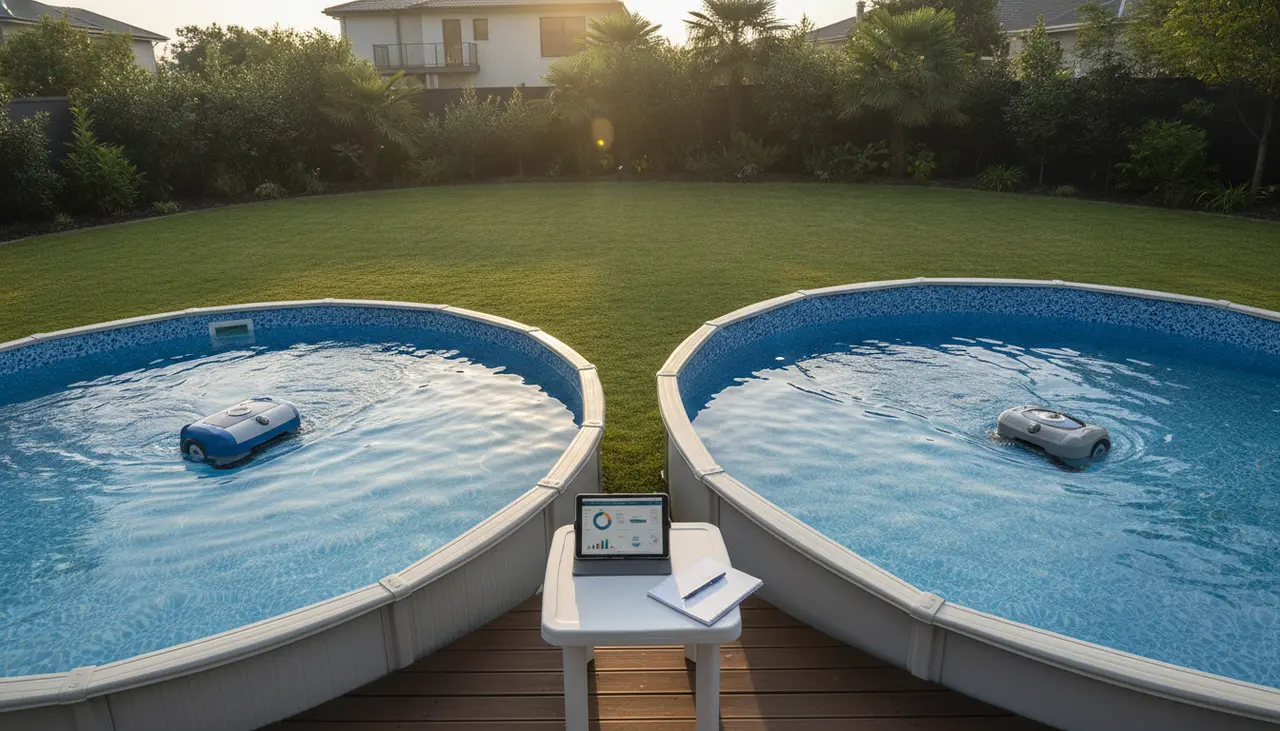
Review: Robotic Pool Cleaners for Above Ground Basins
The Direct Answer: Choosing the Right Above Ground Pool Robot Cleaner
An above ground pool robot cleaner is an autonomous unit that operates independently of your pool's primary pump and filter. For standard flat-bottom basins, a basic floor-climbing model with a 100-micron filter is sufficient. However, if your pool features a "dished" or "expanded" bottom—common in professional installs to increase depth—you require a robot with high-traction treads and a sophisticated onboard gyroscope to prevent the unit from becoming trapped in the center depression.
Buyer-Intent Introduction: Why Infrastructure Compatibility Matters
This guide is designed for property owners who want to reduce the mechanical strain on their filtration systems. Unlike suction-side or pressure-side cleaners, robotic cleaners use internal motors to provide both propulsion and suction. This prevents large debris from clogging your skimmer basket or entering your sand filter, effectively extending the lifespan of your media and pump seals.
Before investing, it is critical to understand how your pool’s infrastructure—specifically the frame type and liner thickness—interacts with the weight and movement of a robotic unit. For a broader look at how these tools fit into your overall setup, refer to The Pool Logic Master Buying Guide: Infrastructure, Filtration, and Maintenance.
Technical Specification Comparison
The following table compares the core metrics of robotic cleaners typically used in above ground environments.
| Feature | Entry-Level Cordless | Mid-Range Corded | High-Performance Corded |
|---|---|---|---|
| Ideal Basin Shape | Flat Bottom | Flat / Slight Dish | Flat / Dished / Coved |
| Cleaning Cycle | 60–90 Minutes | 2 Hours | 2–3 Hours |
| Filtration Rating | 180 Microns | 100 Microns | 2–50 Microns |
| Drive System | Dual-Wheel | All-Wheel / Tread | Track-Driven |
| Suction Rate | ~2,500 GPH | ~3,000 GPH | ~4,000+ GPH |
Performance Analysis: Flat-Bottom vs. Dished-Bottom Basins
The geometry of your pool floor is the single most important factor in robot performance.
Flat-Bottom Basins
In a standard above ground pool, the floor is leveled to a 1-inch variance. Most entry-level robots excel here. Because there is no incline, the robot does not require high-torque motors to maintain its path.
- Logic: Simple "bounce" or "zig-zag" patterns work effectively.
- Risk: Low. The primary concern is ensuring the cord (if applicable) is long enough to reach the furthest radius.
Dished-Bottom (Expanded) Basins
Some installers excavate a "hopper" or dish in the center of the pool before installing the liner. This creates a slope.
- Logic: Standard robots often slide into the center and lack the traction to climb back up the incline.
- Requirement: You must look for units with "Track-Drive" systems (similar to a tank) rather than wheels. These provide more surface area contact with the vinyl, ensuring the robot can navigate the transition from the center dish to the outer wall.
Use-Case Recommendations
Best for Large Circular Pools (21ft - 30ft)
For larger volumes, corded models are preferred over battery-operated units. A 24-foot pool has significantly more surface area than a 15-foot pool, and battery units often lose suction power as the charge depletes. High-capacity filter canisters are essential here to manage the volume of debris without requiring a mid-cycle empty.
If you are currently managing a large pool with a standard filter, you might find that offloading the cleaning to a robot allows you to optimize your turnover rates. See our analysis on Best Sand Filters for 18-Foot Circular Pools: GPH and Turnover Analysis for more on how filtration and cleaning work together.
Best for Fine Debris and Silt
If your pool is located near construction sites or sandy soil, look for a robot compatible with "Ultra-Fine" filter cartridges. While standard mesh filters (100+ microns) catch leaves and bugs, they allow fine silt to pass through and settle back on the floor. A robot with a 2-micron pleated filter can remove particles invisible to the naked eye.
Practical Tradeoffs: Corded vs. Cordless
- Corded Robots:
- Pros: Consistent suction power; unlimited runtime; generally more powerful motors for scrubbing.
- Cons: Requires a GFCI outlet within 30-50 feet; potential for cord tangling (unless equipped with a swivel).
- Cordless (Battery) Robots:
- Pros: No cord tangling; easier to use in "pop-up" style pools (Intex/Bestway) where electrical access is limited.
- Cons: Limited runtime (usually 60-90 mins); battery degradation over 2-3 years; requires manual retrieval via hook when the cycle ends.
Common Beginner Mistakes
- Ignoring the "Cove": If your pool has a steep cove (the transition between the floor and the wall), some robots may get stuck or flip. Ensure the robot is rated for "above ground coves."
- Leaving the Robot in During Shocking: High chlorine levels (above 5ppm) can degrade the plastic components and rubber seals of a robotic cleaner. Always remove the robot before chemically treating the water.
- Neglecting the Filter Mesh: Failing to rinse the internal filter after every cycle causes the motor to work harder, leading to premature "burnout."
- Water Temperature Extremes: Most robotic cleaners are designed for water between 50°F and 95°F. Using them in near-freezing water can make the plastic brittle and the treads less pliable.
FAQ: Above Ground Pool Robot Cleaners
Q: Can a robotic cleaner climb the walls of an above ground pool? A: Some high-end models can, but it is often unnecessary. Unlike in-ground pools with tile lines, above ground pool dirt primarily settles on the floor. Wall-climbing models are more expensive and can occasionally put stress on the top rails of lighter-duty frames.
Q: How often should I run the robot? A: For optimal maintenance, run the robot 2–3 times per week. This prevents bio-film (algae) from gaining a foothold on the liner surface.
Q: Do I need to remove my solar cover to use the robot? A: Cordless robots can usually run under a solar cover. Corded robots may struggle as the floating cable can get tangled in the cover's bubbles.
Affiliate Disclosure: This post contains affiliate links for pool maintenance hardware. If you purchase a robotic cleaner through these links, Pool Logic may earn a commission at no additional cost to you. Our recommendations are based on technical specifications and manufacturer data.