
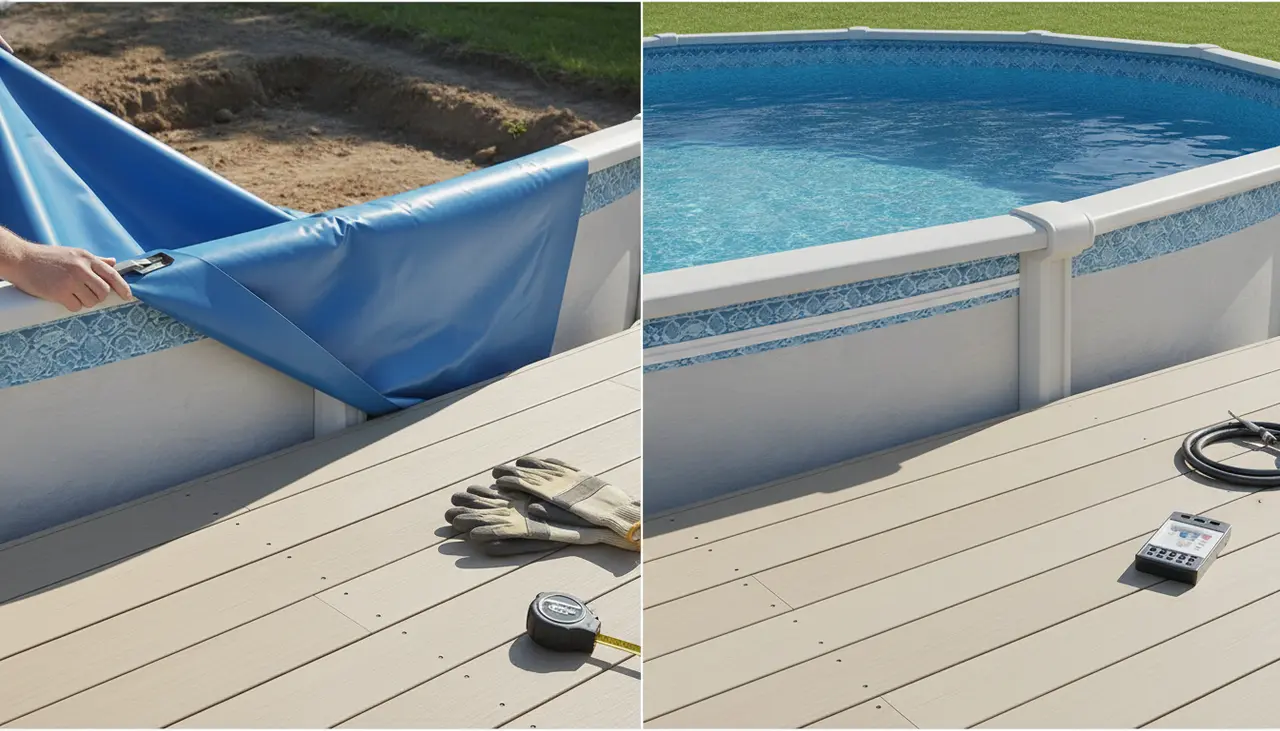
Heavy-Duty Overlap vs Bead Liners: Which is Better?
Affiliate Disclosure: This guide contains affiliate links to premium vinyl liners and installation hardware. If you purchase through these links, we may earn a commission at no additional cost to you.
The choice between an overlap liner and a bead liner is one of the most critical decisions during the assembly or refurbishment of an above ground pool. This choice dictates not only the initial installation labor but also how much effort will be required when the liner eventually needs replacement in 10 to 15 years.
The Direct Answer: Overlap vs. Bead Liners
For most property owners, a bead liner (specifically the Unibead variety) is the superior choice due to its versatility and the fact that it does not require the removal of the pool’s top rails for future replacements. However, overlap liners remain the industry standard for those on a strict budget or for pools with slight wall height variances, as they offer the most flexibility during the initial stretching process.
If your priority is a clean, professional "tile-line" look and ease of long-term maintenance, choose a bead liner. If you are looking for the lowest entry cost and a forgiving installation process, the overlap liner is the practical solution.
Understanding Above Ground Pool Liner Types
This guide is designed for property owners who are either installing a new steel or resin frame pool or are preparing for a liner replacement. Selecting the wrong type can lead to structural stress on the pool wall or a failure to achieve a watertight seal.
1. Overlap Liners
Overlap liners are designed to draped over the pool wall. The excess material hangs over the outside of the pool and is secured using plastic coping strips before the top plate and rail are installed.
- Installation Logic: The liner is pulled taut manually. You have more "play" to adjust for ground that isn't perfectly level (though you should always aim for a variance of less than 1 inch).
- Aesthetics: Because the material overlaps the wall, you cannot have a decorative border or "tile print" at the water line, as it would likely be uneven.
2. Bead Liners (Standard Bead)
Standard bead liners feature a thick groove or "bead" at the top edge. This bead snaps into a "bead receiver" track that is mounted to the top of the pool wall.
- Installation Logic: The receiver stays in place permanently. When the liner needs replacing, you simply pull the old bead out and snap the new one in without touching the pool's top rails.
- Aesthetics: These allow for precise patterns and tile-print borders because the liner height is fixed.
3. Unibead / J-Hook Liners
The Unibead liner is a hybrid. It features a "J" shape at the top that can hook directly over the pool wall (acting like a high-end overlap) or be converted into a bead liner by removing a small strip of vinyl.
Technical Comparison Table
| Feature | Overlap Liner | Bead (Standard/J-Hook) |
|---|---|---|
| Attachment Method | Plastic Coping Strips | Bead Receiver or J-Hook |
| Installation Difficulty | Moderate (Requires manual tensioning) | Low (Snaps into place) |
| Future Replacement | High (Must remove all top rails) | Low (Rails remain in place) |
| Aesthetic Options | Limited (Solid or floor patterns) | High (Tile-line borders) |
| Cost Profile | Most Affordable | Premium |
| Wall Height Tolerance | High (Adjustable) | Low (Must match wall height exactly) |
For a deeper look at how these components integrate with your overall pool structure, refer to The Pool Logic Master Buying Guide: Infrastructure, Filtration, and Maintenance.
Best Use-Case Scenarios
Best for DIY First-Timers: Overlap Liners
If you are worried about precise measurements, the overlap liner is the most forgiving. Because you manually pull the vinyl over the wall, you can compensate for minor inconsistencies in the sand base or pool floor cove.
Best for Saltwater Systems: Resin-Compatible Bead Liners
When using saltwater chlorine generators, corrosion is a concern. Using a bead liner with a resin bead receiver prevents the liner from resting directly against the metal wall at the top, reducing the risk of localized oxidation. For more on material durability, see our analysis of Steel vs. Resin Pool Frames: Durability and Corrosion Comparison.
Best for Longevity and Aesthetics: 25-Gauge Unibead
A heavy-duty 25-gauge (approx. 20 mil) Unibead liner provides the thickest wear layer and the most professional finish. The J-hook attachment ensures the liner stays perfectly centered without the "slipping" sometimes seen with cheap overlap coping.
Common Beginner Mistakes to Prevent
- Installing in Cold Weather: Vinyl loses its elasticity below 70°F (21°C). If you attempt to stretch an overlap or bead liner into place on a cold day, you risk tearing the seams or creating "crow's feet" wrinkles that trap debris.
- Neglecting the Cove: You must have a consistent 6-to-8-inch "cove" (a transition of sand or foam) between the floor and the wall. Without this, the weight of the water will pull the liner down, potentially snapping the bead or tearing the overlap.
- Using an Undersized Liner: Ensure you measure your wall height correctly (typically 48, 52, or 54 inches). A 48-inch liner will not stretch to a 52-inch wall without catastrophic failure.
- Improper Chemical Balancing: High chlorine levels or low pH can cause "liner bleaching" and brittleness. Proper chemistry is essential for maintaining the UV-resistant topcoat of premium liners.
Frequently Asked Questions
Can I convert an overlap pool to a bead liner? Yes. You can purchase "bead receiver" tracks that sit on top of your pool wall. Once these are installed, you can use any standard bead liner. This is a highly recommended upgrade during your first liner replacement.
What is the difference between "Gauge" and "Mil"? "Mil" is a true measurement (1/1000th of an inch), whereas "Gauge" is a marketing term used by some manufacturers that can be inconsistent. Always look for the actual mil thickness if available; a 20-mil liner is generally considered heavy-duty for above ground use.
How long do these liners typically last? A standard 20-gauge overlap liner typically lasts 5–9 years, while a premium 25-gauge bead liner can last 12–15 years, depending on UV exposure and chemical maintenance.
Does liner color affect water temperature? Yes. Darker blue liners can increase water temperature by 3–5 degrees Fahrenheit compared to light blue or white liners by absorbing more solar radiation.