
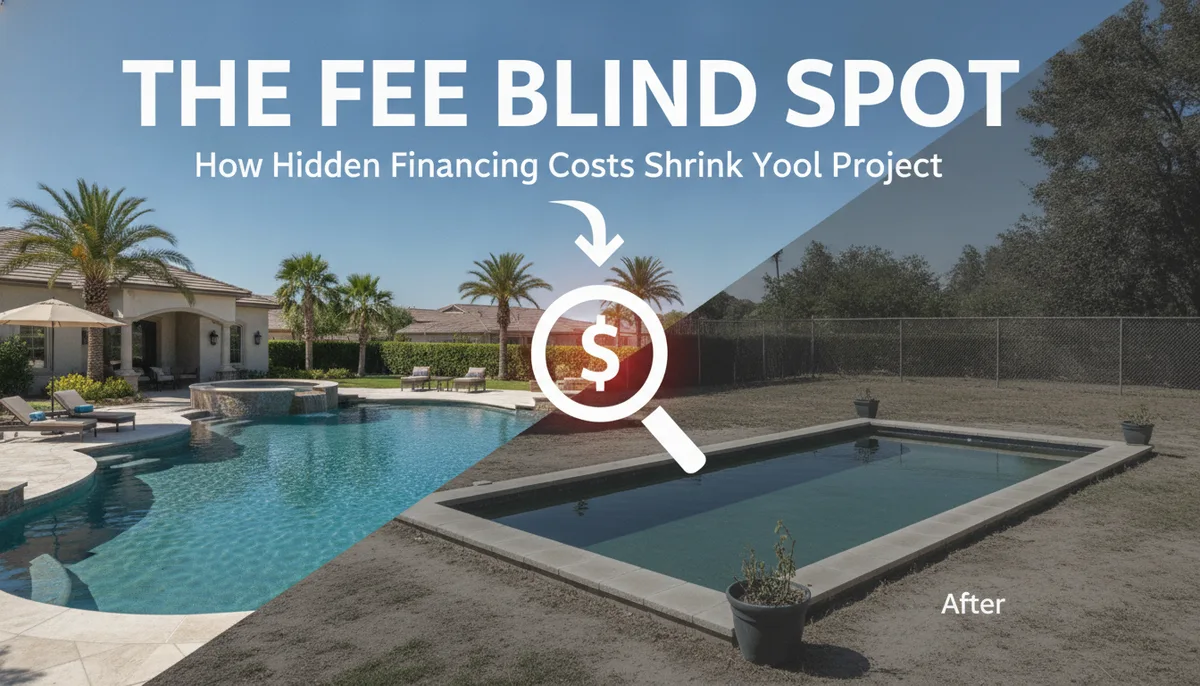
The Fee Blind Spot: How Hidden Financing Costs Shrink Your Pool Project
For most homeowners, the journey to a backyard oasis begins with a vision: crystal clear water, a sun shelf for lounging, and perhaps an integrated spa for cool autumn evenings. However, between that vision and the first splash lies a critical hurdle that many builders and homeowners overlook until it is too late—the financing "fee blind spot."
Many pool builders naturally prefer to focus on the craftsmanship of the vessel and the aesthetics of the landscape, leaving the financial arrangements entirely to the homeowner. While this seems like a way to simplify the business relationship, it often creates a disconnect that can shrink the scope of the project or derail it entirely. As Jessie Wood, senior business development manager at Lyon Financial, points out, financing fees are not just a bank's concern; they are a direct competitor for the homeowner’s backyard budget.
The Hidden Cost of the "Hands-Off" Financing Approach
It is a common misconception in the pool industry that if a builder doesn't pay a financing fee, the financing doesn't affect their bottom line. In reality, the structure of a customer’s loan is the foundation upon which the entire project is built. When builders leave homeowners to research financing on their own, those customers often stumble into loan products that aren't optimized for major home improvements.
Homeowners may gravitate toward traditional personal loans or high-fee home equity products because they are familiar with their local bank. Unfortunately, these products often come with "borrower fees" that are hidden in the fine print. When a homeowner realizes that 5% or 6% of their approved loan amount is being diverted to administrative costs, their first instinct is rarely to increase their debt; instead, they scale back the project.
By the time the builder sits down to finalize the contract, the homeowner has already mentally "cut" the heater, the premium pebble finish, or the LED lighting package to cover the bank's fees.
How High Fees Directly Shrink Your Backyard Vision
The math of financing fees is unforgiving. For every dollar spent on loan origination or closing costs, one dollar is subtracted from the physical backyard.
Consider a $100,000 pool project. If a homeowner secures a loan that carries a 6% borrower fee—a figure not uncommon in certain unsecured lending markets—that represents $6,000 that never reaches the builder’s hands.
“As a builder, ask yourself whether you’d rather see that $6,000 added to the project or paid in financing fees,” Wood suggests. That $6,000 is the difference between a standard pool and a premium outdoor living space. It could cover:
- A high-end automatic pool cover.
- An upgraded outdoor kitchen island.
- A complete Variable Speed vs Single Speed Pool Pumps: An Above Ground Efficiency Comparison setup that saves the homeowner money on utilities for years to come.
When financing fees compete with the project for the homeowner’s budget, the project almost always loses. This "budget cannibalization" leads to smaller sales for the builder and a less-than-ideal finished product for the homeowner.
Comparing Financing Options: Moving Beyond Interest Rates
When evaluating how to fund a pool, the interest rate is usually the first (and sometimes only) number a homeowner looks at. However, the interest rate is only one component of the total cost of capital. To truly protect your buying power, you must look at the total "cost of the loan."
Unsecured Loans vs. Home Equity
Traditional home equity products, such as HELOCs, often boast lower interest rates. However, they may come with appraisal costs, title searches, and closing fees that can total thousands of dollars. Furthermore, the timeline for these loans can be weeks or months, potentially delaying construction.
Conversely, some "low-rate" unsecured loans mask their true cost through high origination fees. An 8% interest rate with a 5% origination fee may actually be more expensive over the first few years than a 9% rate with zero fees.
The Draw Process and Project Momentum
Beyond the fees, the way a lender handles "draws" (the release of funds at specific construction milestones) can affect the project's success. Lenders who specialize in pools understand the unique stages of construction—excavation, steel, gunite, and tile. Lenders who do not understand this industry may hold back funds at critical moments, causing delays that frustrate the homeowner and strain the builder’s cash flow.
Strategic Questions to Protect Customer Buying Power
To avoid the fee blind spot, builders and homeowners should engage in a more transparent conversation about the financing partner. You don't need to be a financial expert to identify a predatory or inefficient loan structure.
According to Jessie Wood, asking a few targeted questions can reveal whether a financing solution is truly "project-friendly":
- What is the total origination fee? This is often a percentage of the loan. If the fee is 5% on a $150,000 loan, that’s $7,500 gone before the first shovel hits the ground.
- Are there prepayment penalties? Many homeowners intend to pay off their pool loan early using a bonus or the sale of a home. A penalty for doing so adds an unnecessary layer of cost.
- Is the loan's APR significantly higher than the interest rate? A large gap between these two numbers almost always indicates high upfront fees.
- Does the lender pay the builder directly? A streamlined payment process ensures the project stays on schedule and reduces the administrative burden on the homeowner.
By vetting lenders based on these criteria, builders can recommend partners that keep the customer’s budget focused where it belongs: on the construction and safety of the pool. For instance, ensuring the budget allows for proper Pool Electrical Safety: A Comprehensive Guide to Bonding, Grounding, and Inspections is far more important than paying a bank an administrative fee.
The Builder's Role in the Financing Experience
While it is true that the homeowner is the one signing the loan documents, the financing process is inextricably linked to the builder’s reputation. If a homeowner has a stressful, fee-heavy experience with a lender, that frustration often bleeds into their perception of the entire project.
"The financing process becomes part of the customer experience," Wood explains. When a builder takes a proactive role—not by giving financial advice, but by recommending specialized pool lenders—they are protecting the integrity of the sale.
A specialized lender like Lyon Financial understands that a pool is an appreciating asset for the home. They structure loans to maximize the "backyard dollar," ensuring that the homeowner feels confident moving forward with the full scope of their dream rather than a stripped-down version.
Maximizing Project ROI with Smart Budget Allocation
When the "fee blind spot" is eliminated, the homeowner suddenly has more room to breathe. Instead of worrying about how to cover a $5,000 closing cost, they can invest that money into long-term durability and enjoyment.
For example, those "found" dollars could be used for:
- Automation Systems: Allowing the homeowner to control chemistry and lighting from their smartphone.
- Enhanced Sanitation: Moving from basic chlorine to ozone or UV systems.
- High-Quality Maintenance Gear: Investing in a can reduce the manual labor required to keep the new investment pristine.
Furthermore, a properly funded project allows for better adherence to professional standards. Whether it's choosing the right thickness for a Solar Cover Thickness Guide: 8mm vs 12mm or ensuring the decking is finished with the highest quality materials, a budget that isn't eroded by fees is a budget that delivers a better ROI.
Conclusion: Taking Control of the Conversation
Financing should be a tool that enables a dream, not a hurdle that diminishes it. For builders, understanding the impact of borrower fees is a matter of business survival; it is the difference between a $120,000 contract and a $90,000 contract. For homeowners, it is the difference between getting the pool they wanted and getting the pool the bank's fee structure allowed them to have.
By shining a light on the fee blind spot, both parties can ensure that every dollar of the budget is used to create a beautiful, safe, and lasting backyard environment. Don't let your project be defined by what you had to cut—let it be defined by the quality you were able to keep.