
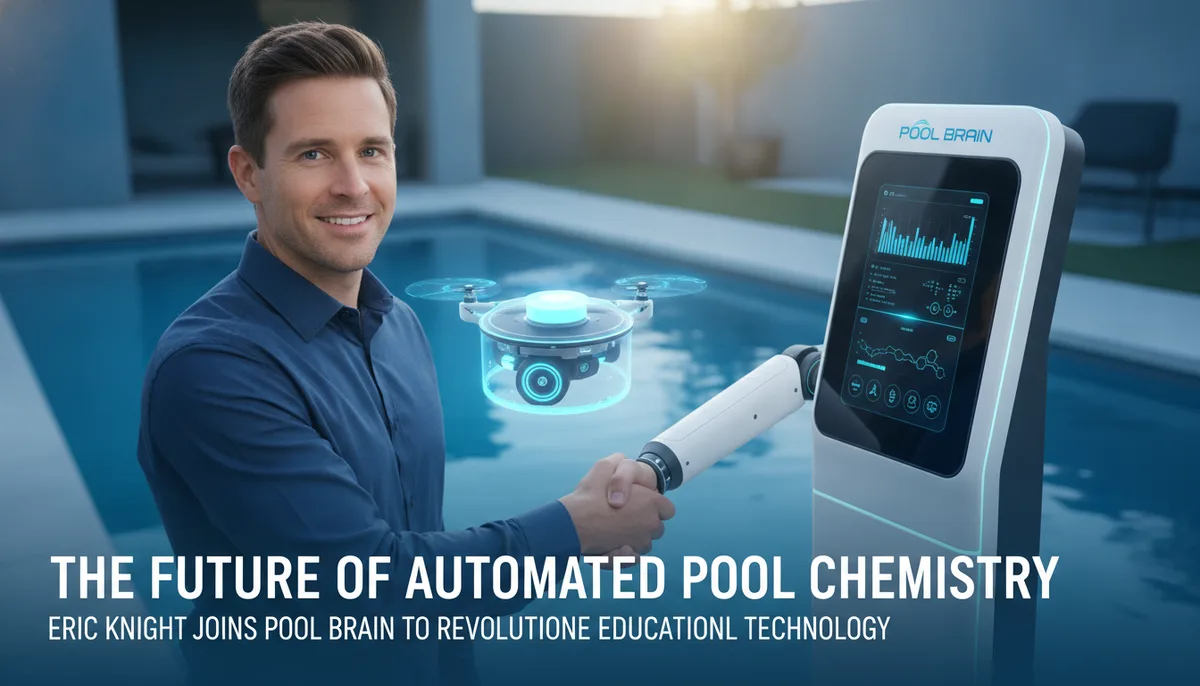
The Future of Automated Pool Chemistry: Eric Knight Joins Pool Brain to Revolutionize Educational Technology
The professional pool industry is currently at a critical intersection where traditional field expertise meets high-level software integration. This convergence was solidified recently with the announcement that Eric Knight, the inaugural Executive Director of Watershape University and a long-time leader at Orenda, has moved to Pool Brain as the Head of Educational Technology.
This transition is more than just a leadership change; it represents a fundamental shift in how pool service companies will operate in the coming decade. By bringing one of the industry’s most respected educators into the fold of a leading software provider, the industry is signaling that "smart" pool management is no longer just about tracking data—it is about the automated, intelligent application of chemistry and the real-time education of the workforce.
The Evolution of Eric Knight: From Orenda to Watershape U to Pool Brain
To understand the impact of this move, one must look at Eric Knight’s trajectory. Knight spent years with Orenda, a company that revolutionized how pool professionals view the Langelier Saturation Index (LSI) and chemical minimalism. His tenure at Orenda was defined by a "less is more" philosophy, focusing on proactive water balance rather than reactive chemical dosing.
In 2025, Knight took the helm at Watershape University, an institution dedicated to the highest standards of pool design, construction, and engineering. His move to Pool Brain, a software company, suggests that the next frontier for pool excellence isn't just in the physical build or the chemical bottle, but in the digital logic that connects them.
At Pool Brain, Knight is tasked with overseeing the advancement of fully automated water chemistry dosing. This move bridges the gap between theoretical chemistry and practical, automated application, ensuring that the "Orenda-style" precision can be scaled through technology.
Why Automated Water Chemistry Dosing is the New Standard
For decades, pool chemistry was a manual, often "best-guess" endeavor. Technicians would test water, refer to a chart, and hand-pour chemicals. However, even the most experienced technician can make errors in calculation or application.
Fully automated dosing systems change the equation by utilizing sensors and precision pumps to maintain water balance 24/7. When integrated with software like Pool Brain, these systems can:
- Maintain Constant LSI Balance: Instead of the "yo-yo" effect of weekly dosing, automation provides micro-doses that keep the water in a constant state of equilibrium.
- Reduce Chemical Waste: Automation ensures that only the exact amount of chemical needed is used, saving money and protecting the pool surface.
- Provide Remote Oversight: Service managers can see the chemical status of a pool in real-time without being on-site.
For professionals looking to implement these systems, choosing the right hardware is essential.
automated pH and ORP controller system
Bridging the Education Gap with Guided Technology
One of the greatest challenges in the pool industry is the labor shortage and the "knowledge gap." High turnover rates often mean that relatively inexperienced technicians are responsible for maintaining expensive backyard assets.
Knight’s role as Head of Educational Technology is specifically designed to address this. By creating "guided training" within the software, Pool Brain is essentially putting a master educator in the pocket of every technician. Imagine a scenario where a technician enters a reading into their app, and the software—powered by Knight’s educational logic—not only tells them what to do but explains why it is necessary.
This real-time education is critical because Beyond the Splash: Why Pool Water Is Not a Surface Disinfectant. Understanding that water chemistry is about more than just "clear water"—it’s about safety and sanitation—requires a level of training that many companies struggle to provide consistently.
The Intersection of Software Logic and Chemical Precision
Pool Brain has already established itself as a powerful tool for service management, but the integration of automated dosing logic moves it into the realm of "predictive maintenance."
When software understands the volume of the pool, the local weather patterns, and the historical chemical trends of a specific body of water, it can begin to predict needs before they become problems. For example, if the software knows a heatwave is coming, it can instruct the automated system to slightly increase sanitizer levels or adjust the pH to compensate for increased evaporation and bather load.
This level of sophistication requires a deep understanding of hydraulic flow and filtration. A system is only as good as the water's circulation. Professionals often find that upgrading to more efficient equipment, such as those discussed in our guide on Variable Speed vs Single Speed Pool Pumps, is a prerequisite for successful automation.
The Impact on Professional Service Standards
The hiring of Eric Knight by a software firm sends a clear message: the future of the pool professional is "tech-enabled."
In the past, a "good" pool guy was someone who showed up on time and kept the water clear. In the future, a "professional" pool service provider will be defined by their ability to manage complex digital ecosystems. They will be data analysts as much as they are service technicians.
By automating the "grunt work" of chemical dosing, technicians are freed up to focus on higher-level tasks, such as:
- Preventative equipment maintenance.
- Leak detection and structural inspections.
- Client communication and backyard consultations.
This shift professionalizes the industry, allowing companies to charge more for a higher tier of service that guarantees water safety and equipment longevity through science and technology.
Implementing Automation: What Pool Pros Need to Know
If you are a pool service business owner looking to follow the lead of industry innovators like Knight and the Pool Brain team, the transition to automation should be handled in phases.
Phase 1: Data Integration
Start by using service software to track every reading. You cannot automate what you do not measure. Establishing a baseline of chemical usage and water behavior is the first step toward automation.
Phase 2: Semi-Automation
Introduce automated feeders for primary sanitizers. This reduces the manual handling of chemicals and begins the process of stabilizing the water environment.
professional grade peristaltic dosing pump for pool chemicals
Phase 3: Full Integration and Remote Monitoring
The final phase involves connecting your controllers to a central software hub. This allows for the "guided training" and "automated dosing" that Knight is currently developing. It ensures that every adjustment made to the water is backed by the logic of the LSI and the oversight of the company’s best experts.
Conclusion: A New Era for Pool Logic
The move of Eric Knight to Pool Brain is a landmark moment for the pool industry. It marks the end of the era of "guesswork chemistry" and the beginning of "logical automation." As educational content becomes more integrated with the tools we use daily, the barrier to entry for high-level pool care will lower, while the ceiling for what a professional service can provide will rise.
For the homeowner, this means safer, more consistent water. For the professional, it means a more scalable, profitable, and respected business model. The synergy between Watershape University’s high-level standards and Pool Brain’s technological reach is a win for the entire backyard industry.
As we look toward 2026 and beyond, the question for pool pros is no longer if they will adopt these technologies, but how fast they can integrate them to stay competitive in an increasingly sophisticated market.