
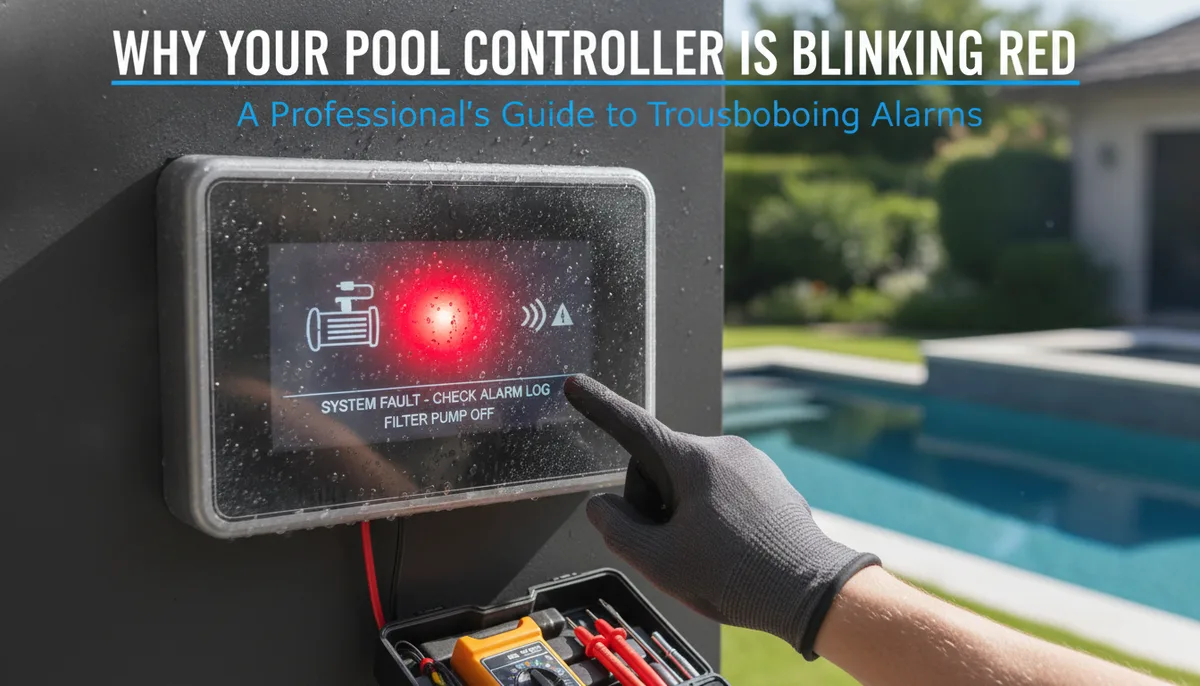
Why Your Pool Controller is Blinking Red: A Professional's Guide to Troubleshooting Alarms
The Psychology of the Blinking Light: Why We Ignore the Signs
Imagine you are driving down a highway at 70 miles per hour. Suddenly, a bright red "Check Engine" light illuminates on your dashboard. Do you reach for a piece of electrical tape to cover the light and keep driving? Likely not. You understand that the light is a symptom of an underlying mechanical issue that, if ignored, could lead to a catastrophic engine failure or a dangerous breakdown.
In the world of professional aquatics, the chemical controller is the "brain" of your pool’s circulation system. Yet, many facility managers and operators have developed a dangerous habit: alarm fatigue. It is common to walk into a pump room and see a controller blinking red, only for the operator to ignore it during a twenty-minute conversation.
When a control system displays an alarm, it should be a surprise—an anomaly that demands immediate investigation. If the red light is always blinking, the system is no longer providing you with the safety and oversight it was designed for. To regain control, we must differentiate between "nuisance alarms" and "critical failures" and take the necessary steps to ensure the controller only speaks when it has something important to say.
Identifying and Eliminating Nuisance Alarms
A "nuisance alarm" is an alert triggered by a parameter that is either not critical to your current operation or is caused by routine maintenance tasks. When these alarms happen daily, operators become numb to the red light.
The LSI and Manual Data Entry
Many modern controllers, such as those from ProMinent, can calculate the Langelier Saturation Index (LSI) to help manage water balance and prevent scaling or corrosion. However, the LSI calculation often requires manual input of variables like calcium hardness and cyanuric acid. If an operator fails to update these numbers, the LSI reading may drift into an "alarm" state. If you are not actively using the controller to monitor LSI, it is better to disable that specific alarm threshold than to let it blink indefinitely.
Flow Alarms During Maintenance
One of the most frequent causes of alarm fatigue is the flow sensor. When you backwash a sand filter or perform a "bump" on a regenerative media filter, the water flow to the sensor cell often drops. The controller sees this as a "No Flow" condition and triggers an alarm to prevent the chemical feeders from pumping into stagnant water.
You can solve this by adjusting the "alarm delay" or "flow logic" settings. By allowing a grace period—perhaps five to ten minutes—you can complete a backwash cycle without the controller going into a hard alarm state. This ensures that the red light only stays on if the flow fails to return after the maintenance task is finished.
Temperature Fluctuations
Temperature alarms are often set too tightly. If your goal is a 78-degree pool, setting a high alarm at 79 and a low at 77 is asking for trouble. Ambient air temperature, bather load, and heater cycles will cause natural fluctuations. Widening these windows to a more realistic range (e.g., 74 to 82 degrees) ensures the alarm only triggers when there is a genuine heater failure or a probe error.
Decoding Critical Chemical Alarms: pH, ORP, and PPM
Once the "noise" of nuisance alarms is silenced, the remaining alerts usually point to critical water chemistry issues. These are the alarms that protect your bathers and your facility's infrastructure.
High and Low Limit Alarms
Most controllers monitor pH and either ORP (Oxidation-Reduction Potential) or PPM (Parts Per Million) of chlorine. If the pH climbs too high, the chlorine becomes ineffective; if it drops too low, the water becomes corrosive to the pool surface and equipment.
When a high or low limit alarm triggers, ask the following questions:
- Is the sensor reading accurately? Always verify the controller’s reading with a high-quality manual test kit.
- Is the feeder functioning? Check if the chemical vat is empty, if the pump tube is ruptured, or if the injection point is clogged with calcium deposits.
- Is the set point realistic? If the controller is constantly chasing a set point it can never reach, the parameters may need adjustment.
For those managing complex systems, ensuring the physical integrity of the pump room is just as vital as the digital settings. Issues with grounding or bonding can sometimes cause "stray voltage," which interferes with sensitive sensor readings. For more on this, see our Pool Electrical Safety: A Comprehensive Guide to Bonding, Grounding, and Inspections.
The Role of Proportional Control in Preventing Overshoot
A common cause of "High Limit" alarms is a poorly tuned feed cycle. In a basic "on/off" control setup, the feeder runs at 100% capacity until the set point is reached, then shuts off. However, because it takes time for chemicals to circulate and reach the sensors, the levels often continue to rise even after the pump stops. This is known as "overshooting."
Advanced controllers use Proportional Control. This means as the water chemistry approaches the desired set point, the controller slows down the feed rate (often by pulsing the pump). If your controller is frequently alarming for "High pH" shortly after a feed cycle, you likely need to adjust the "Proportional Band" settings. This fine-tuning ensures that the chemical levels glide into the set point rather than crashing through it and triggering an alarm.
Sensor Maintenance: The First Line of Defense
A controller is only as good as the data it receives. If a sensor is dirty, scaled, or depleted, it will provide "ghost" readings that lead to unnecessary alarms.
Cleaning and Calibration
Sensors (probes) live in a harsh environment. Over time, they can become coated in oils, bather waste, or calcium scale. A dirty ORP probe might read 100mV lower than the actual water condition, causing the controller to over-chlorinate the pool.
- Weekly: Check the sensor reading against a manual DPD test.
- Monthly: Clean the probes using a mild acid solution or a dedicated sensor cleaning kit.
- Annually: Most electrochemical sensors have a lifespan of 12–24 months. If a sensor becomes sluggish or won't hold a calibration, it is time for a replacement.
While maintaining proper chemistry is essential for bather comfort and equipment longevity, it is also a matter of public health. Remember that while automated systems keep the water clear, they do not replace the need for surface hygiene and proper facility protocols. To understand the limits of pool water as a sanitizer, read our article Beyond the Splash: Why Pool Water Is Not a Surface Disinfectant.
Troubleshooting Checklist for Persistent Alarms
If you are facing a persistent alarm that refuses to clear, use this professional troubleshooting hierarchy:
- Verify the Flow: Ensure the flow through the bypass line (where the sensors are located) is adequate. A clogged pre-filter or a closed valve on the sensor-cell line is a common culprit.
- Manual Cross-Check: Use a to confirm the actual water chemistry. If the manual test matches the controller, the problem is mechanical (feeder/chemical). If they don't match, the problem is the sensor or the calibration.
- Check Feed Logic: Look at the "Feed Limit" or "Overfeed Timer." Most controllers have a safety feature that stops the pump if it runs for too long without seeing a change in the water chemistry. This prevents the entire vat of acid from being pumped into the pool if a sensor fails.
- Inspect Electrical Integrity: Ensure there are no power surges or interference from nearby variable speed pumps.
For facilities looking to optimize their pump room efficiency further, comparing equipment types is essential. If your alarms are related to flow fluctuations, you might benefit from the steady performance of modern pump technology. Check out our guide on Variable Speed vs Single Speed Pool Pumps: An Above Ground Efficiency Comparison.
Conclusion: Turning the Red Light Off for Good
A pool controller should be a silent guardian. When it speaks—via a blinking red light or an audible siren—it should be because something requires your immediate professional attention. By taking the time to eliminate nuisance alarms, calibrating your sensors regularly, and tuning your proportional feed settings, you transform the controller from a source of "annoying noise" into a precision instrument.
Don't let alarm fatigue put your facility at risk. The next time you see that red light, don't just clear it. Investigate it, understand the "why" behind the "what," and fix the root cause. Your water quality, your equipment, and your bathers will thank you.