
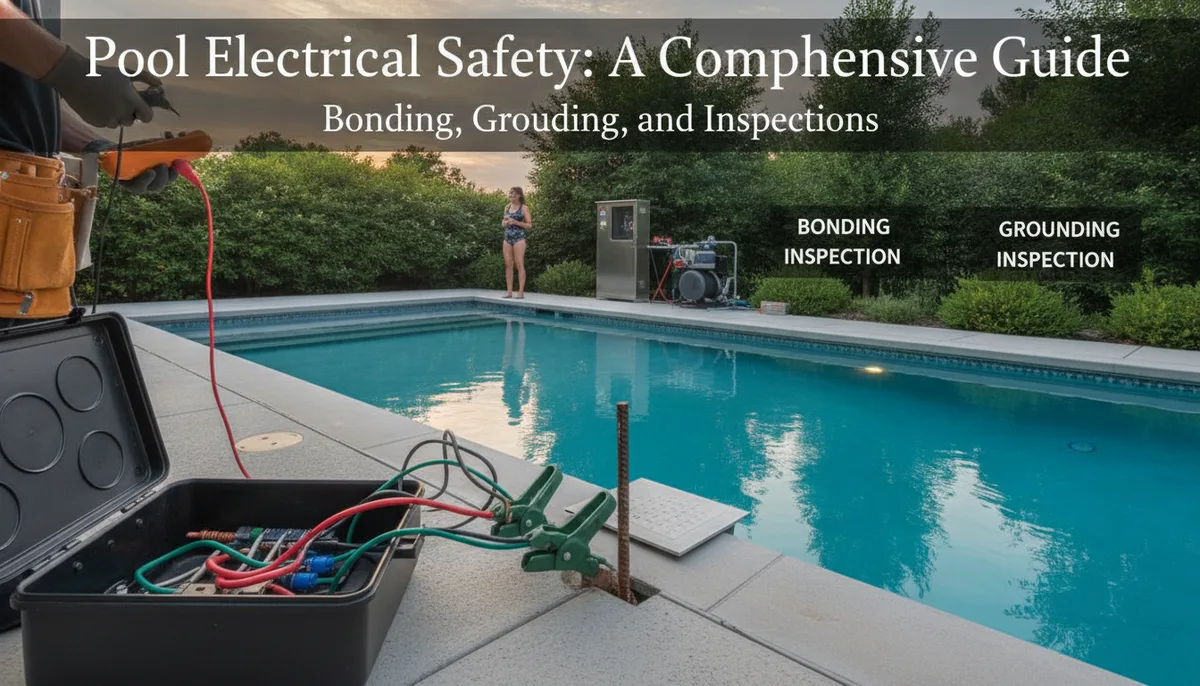
Pool Electrical Safety: A Comprehensive Guide to Bonding, Grounding, and Inspections
Electrical safety in a pool environment is a silent but critical priority. Because water and electricity are a lethal combination, the standards for pool wiring, bonding, and grounding are significantly more stringent than those for standard household circuits. However, as equipment ages or as new components are added by DIY enthusiasts or unqualified technicians, safety margins can erode.
Whether you are a homeowner looking to understand the "red flags" of your system or a professional technician refining your inspection checklist, understanding the nuances of the National Electrical Code (NEC) regarding pools is essential. This guide dives deep into the technical requirements for a safe aquatic environment, from the physics of bonding to the specifics of load calculation.
The Professional Boundary: Knowing When to Call an Expert
Before opening any electrical panel, it is vital to understand the limits of your qualifications and local licensing laws. In many jurisdictions, a specialty pool license may only allow a technician to work from the electrical sub-panel to the pool equipment. Opening the main service panel or handling "line-side" connections often requires a licensed master electrician.
Safety is not just about the equipment; it is about the person handling it. As discussed in our guide on Beyond the Basics: Building a Resilient Culture of Continuous Learning in Pool Service, staying updated on local codes and safety standards is a hallmark of a high-quality service operation. Never operate outside your legal or technical capacity, as panels contain live connections that can be fatal even when the equipment appears to be "off."
The Science of Bonding vs. Grounding
One of the most common points of confusion in pool electrical safety is the difference between bonding and grounding. While they work together, they serve two distinct purposes.
The Purpose of Grounding
Grounding is a safety feature designed to provide a low-resistance path for electricity to return to its source (the electrical panel) in the event of a short circuit or "fault." If a wire becomes loose and touches the metal casing of a pump, the ground wire directs that energy back to the breaker, causing it to trip and cut power.
The Purpose of Bonding (Equipotential Bonding)
Bonding is unique to the pool environment. Its goal is to bring all metal components around the pool to the same "potential" or voltage level. In a pool, even a small difference in voltage between a metal ladder and the water can cause a person to feel a shock. By connecting all metal parts—pumps, ladders, light niches, and even the steel rebar in the pool shell—with a solid copper wire, you ensure that electricity cannot "flow" between them because they are all at the same electrical pressure.
When considering the structural elements of your pool, such as those mentioned in our comparison of Steel vs. Resin Pool Frames: Durability and Corrosion Comparison, remember that any metallic frame or component within five feet of the water's edge must be integrated into this bonding grid.
Performing a Continuity Test
A visual inspection of the bonding wire is not enough. Over time, corrosion or loose lugs can increase resistance, rendering the bond ineffective. To verify the integrity of the system, a continuity test must be performed using a high-quality multimeter.
How to Measure Resistance
To perform the test, set your meter to the ohms (Ω) setting. Touch one probe to the bonding lug on the pump and the other to a bonded component, such as a metal ladder or a fence post within the 5-foot zone.
According to Bill Hamilton, Ph.D., an expert on the National Electrical Code’s pool section, a properly bonded system should register 1 ohm or less on the meter. A reading significantly higher than 1 ohm indicates a lack of continuity, meaning the bond is failing to provide a clear path for electricity. These differences are usually stark; a failed bond will often jump to much higher resistance levels, signaling an immediate need for repair.
GFCI Protection: The Essential Fail-Safe
The Ground Fault Circuit Interrupter (GFCI) is the single most important safety device in your pool’s electrical system. It monitors the balance of electrical current moving through a circuit. If it detects a leakage as small as 4 to 6 milliamperes—an amount that could indicate electricity escaping into the water—it shuts off the power in a fraction of a second.
Common GFCI Shortfalls
A common issue in modern pool installations is the lack of "knockouts" in automation panels. As pools become more complex with multiple pumps, lights, and accessories, installers may run out of space for GFCI breakers.
Some technicians may shortcut the process by putting multiple appliances on a single non-GFCI breaker to save space. This is a dangerous violation of safety standards. Every electrically operated element, from the primary filter pump to the underwater lights, must be protected by a GFCI device. If an automation panel is full, the correct solution is to install a secondary sub-panel to provide the necessary slots for proper GFCI protection.
Evaluating Wire Sizing and Load Calculations
One of the most frequent errors found during electrical inspections is the use of undersized wiring. This is particularly prevalent with the rise of variable-speed pumps.
The Variable-Speed Pump Factor
Historically, many pool pumps operated on 1.5 or 2 horsepower motors, which typically utilized 12-gauge wire. However, many modern variable-frequency-drive (VFD) pumps are rated up to 3 horsepower. These larger motors pull more current and require the "cushion" provided by 10-gauge wire.
Using undersized wire leads to:
- Overheating: Excessive resistance in a thin wire generates heat, which can melt insulation.
- Voltage Drop: The motor receives less power than it needs, leading to premature failure.
- Nuisance Tripping: The heat generated can cause breakers to trip even when there isn't a direct short.
When inspecting the system, verify that the breaker size matches the wire gauge and the equipment's maximum load. For a deeper look at how equipment choices impact your overall infrastructure, refer to The Pool Logic Master Buying Guide: Infrastructure, Filtration, and Maintenance.
Separation of High and Low Voltage
Modern pool automation relies on a mix of high-voltage power (for pumps and heaters) and low-voltage communication (for sensors and control panels). A critical safety rule is that these two types of wiring must never mix.
Low-voltage wires should never be run through the same conduit as high-voltage wires. Furthermore, within the automation panel itself, there is typically a physical barrier or a designated "low-voltage side." Crossing these lines can lead to:
- Electrical Interference: High-voltage lines can create "noise" that disrupts the signals to your pool's sensors.
- Catastrophic Failure: If a high-voltage wire insulation fails and touches a low-voltage communication wire, it can send 240 volts directly into the sensitive logic board of your automation system, destroying it instantly and creating a fire hazard.
Conclusion: A Culture of Safety
Electrical inspections should not be a one-time event during construction. Corrosion, rodents chewing on wires, and the natural vibration of pool equipment can all compromise electrical integrity over time. Experts recommend a thorough check of the bonding, grounding, and GFCI functionality at least once per year.
By staying vigilant about wire sizing, ensuring proper separation of voltages, and insisting on 1-ohm-or-less continuity in your bonding grid, you ensure that the only thing your family feels in the pool is the cool embrace of the water—not the sting of a stray current. Safety in the pool industry isn't just about following rules; it's about protecting the lives of those who use the facility.